


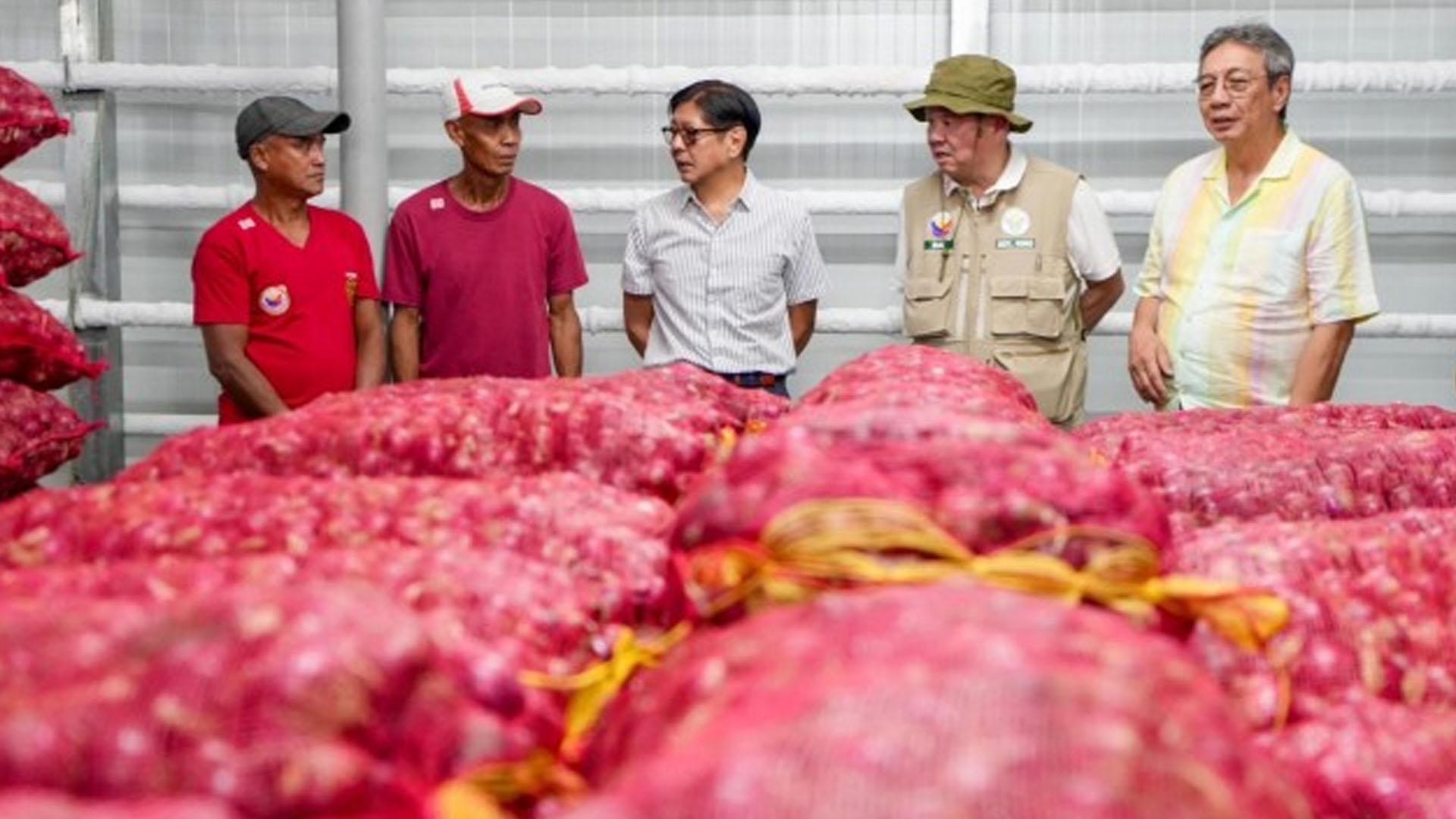






President Ferdinand R. Marcos Jr. on Thursday inspected newly completed post-harvest facilities in Ramon, Isabela aimed at reducing losses and improving farmers’ incomes.
The facilities include the Ambatali Warehouse with Multi-Purpose Drying Pavement and the Ramon Onion Cold Storage Facility in Barangay Ambatali, which are expected to benefit around 1,500 farmers from Isabela and Nueva Vizcaya.
Upon arrival, the President was welcomed by hundreds of farmers gathered at the site. He was joined by Speaker Faustino “Bojie” Dy III and Department of Agriculture (DA) Secretary Francisco Tiu Laurel Jr., along with provincial and local officials, during the inspection.
The DA said the onion cold storage facility has a capacity of up to 20,000 bags, which could prevent spoilage of around 4,000 to 7,000 bags, helping ensure a more stable year-round supply and improved market prices.
The Ambatali Warehouse and drying pavement, meanwhile, can store up to 14,000 cavans of palay and process up to 3,625 sacks per drying cycle, reducing the need for roadside drying that often leads to grain damage, safety risks, and reduced farmgate prices.
The DA said the rollout of cold storage and drying facilities forms part of broader interventions to modernize agriculture, improve supply chain efficiency, and stabilize food prices.
The government is also providing fuel and fertilizer subsidies, as well as financial assistance through the Presidential Assistance to Farmers, Fisherfolk, and Families program, to cushion the impact of rising oil prices on the sector.
Speaker Dy said the newly inaugurated facilities represent concrete steps toward improving the productivity and income of Filipino farmers, stressing that infrastructure investments in agriculture directly translate to food security and economic stability.
“Hindi lang po ito pagbubukas ng mga pasilidad – ito ay pagbubukas ng oportunidad para sa mas maliwanag na kinabukasan ng ating mga magsasaka at ng buong sambayanang Pilipino (This is not just an inauguration – this is opening the opportunities for a brighter future of our farmers and the Filipino people),” Dy said.
The Speaker credited the leadership of President Marcos for prioritizing agriculture, noting that the Chief Executive’s presence at the event reflects the administration’s whole-of-government approach to ensuring food security.
“Kitang-kita natin ang malinaw na direksyon ng Pangulo — ang agrikultura ay hindi pangalawa, kundi pangunahing haligi ng ating ekonomiya (We can evidently see the clear direction of the President – agriculture is not the second, but the primary foundation of the economy),” he added.
He emphasized that beyond infrastructure, the initiative sends a strong signal that government support for farmers is sustained and expanding.
The Speaker assured that the project marks the beginning of broader efforts to ensure that no farmer is left behind and that food security remains at the center of the national agenda.
“Hindi ito ang huling hakbang — ito ang simula ng mas matibay na paninindigan na ang pamahalaan ay katuwang ng magsasakang Pilipino, ngayon at sa hinaharap (This is not the last step – this is just the beginning of a stronger commitment that the government is a partner of the Filipino farmer today and in the future),” Dy said.
Meanwhile, Tiu Laurel led officials in traversing the Rizal-Abra farm-to-market road in Santiago City, a PHP83.16 million infrastructure project funded under the Philippine Rural Development Project.
Completed in January, the upgraded road is expected to cut transport costs by about 20 percent and reduce travel time by half, benefiting 523 farming households, or about 2,206 residents.
The road project is also expected to expand the area planted with mongo, a crop the DA aims to promote to boost farmers’ incomes and reduce reliance on imports.
Tiu Laurel said the projects are part of a broader push to modernize Philippine agriculture and shield farmers from rising global risks.
“These investments are critical as we build a more resilient and efficient food system,” he said.
“With oil prices surging, the cost of fertilizers and transport is rising sharply – threatening farm productivity, squeezing incomes, and pushing food prices higher. By strengthening infrastructure from farm to market, we are protecting both our farmers and consumers while advancing food security.”
Together, the projects address long-standing gaps in transport and post-harvest infrastructure – key constraints that have historically limited farm productivity and incomes – while reinforcing efforts to stabilize food supply and prices. (PNA)