


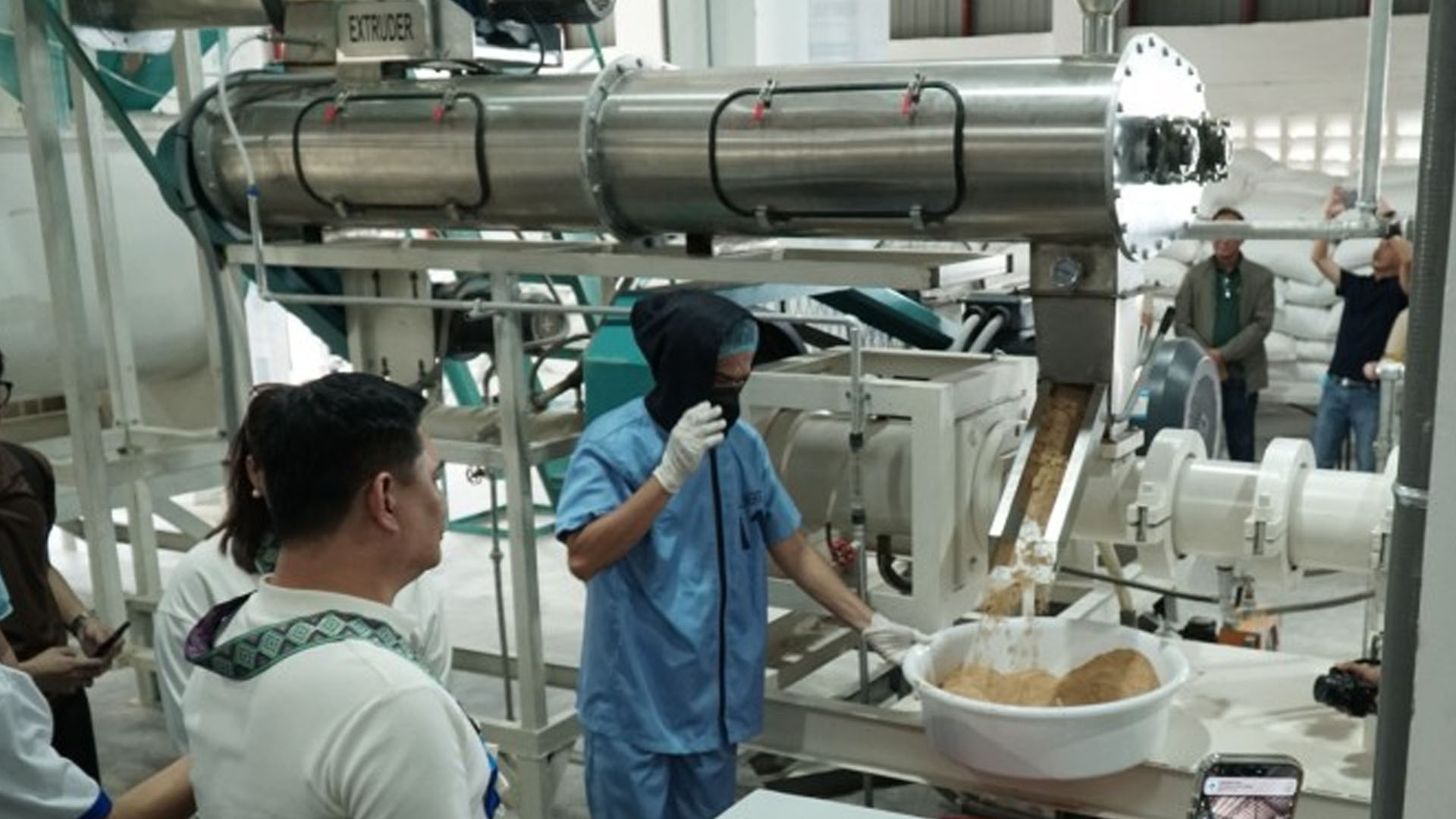






The feedmill facility established inside the Southeast Asian Fisheries Development Center Aquaculture Department (SEAFDEC/AQD) complex in Tigbauan, Iloilo is seen to boost the aquaculture sector in Western Visayas.
The project, which started with the signing of an agreement between the Department of Agriculture-Bureau of Fisheries and Aquatic Resources (DA-BFAR) and SEAFDEC/AQD in 2003, was formally inaugurated on Monday.
BFAR Western Visayas Regional Director Remia Aparri, in her message, said the facility has a production capacity of at least five metric tons of feeds per day and can reach up to eight metric tons.
It was designed to support the development of cost-effective feeds for commercially important fish species, such as bangus (milkfish).
“More importantly, this facility is expected to directly benefit at least 6,240 fisherfolk annually, which is equivalent to approximately 47 percent of the 13,202 fisherfolk engaged in aquaculture out of the 192,679 registered fisherfolk in the entire region. This clearly demonstrates the scale and significance of this intervention in advancing aquaculture productivity in Western Visayas,” she said.
She added that the facility will serve not only as a feed production center but also as a hub for innovation, training, and technology transfer.
It will cater to a wide range of stakeholders, from backyard fish farmers to commercial producers, not only within Western Visayas but also in neighboring regions.
SEAFDEC/AQD chief Dan Baliao, in his message, said the feed mill plant stands as another way for the agency to bridge the gap between research and development and practical application, and a sign of their unwavering commitment to its stakeholders.
“As we flip the switch today and hear the roars of the machinery reverberate around the facility, we do so with the hope that with each pellet produced contributes towards food security and sustainable aquaculture growth,” Baliao said.
DA-BFAR Assistant Director for Administrative Services Zaldy Perez, in his message of support, said the project directly responds to one of the most pressing constraints in aquaculture: the high and unstable cost of feeds.
“Aquaculture now accounts for more than half of the country’s overall fishery production. Despite this, our fish farmers continue to suffer, as feed alone can account for 60 to 70 percent of production costs. This fact diminishes production and profitability, ultimately affecting our ability to assure food security and improve the lives of our fisherfolk,” he said.
He emphasized that the project aimed to “complement the current supply system and address gaps, especially during times when feed prices are high, and supply is constrained.”
“From a national perspective, this initiative aligns squarely with our mandate to achieve food security, increase productivity, and improve incomes in the fisheries sector,” he said. (PNA)