








The Department of Environment and Natural Resources (DENR) has emphasized the need to treat climate resilience as part of the Association of Southeast Asian Nations (ASEAN) security agenda, noting that climate change has become a security threat that should no longer be ignored.
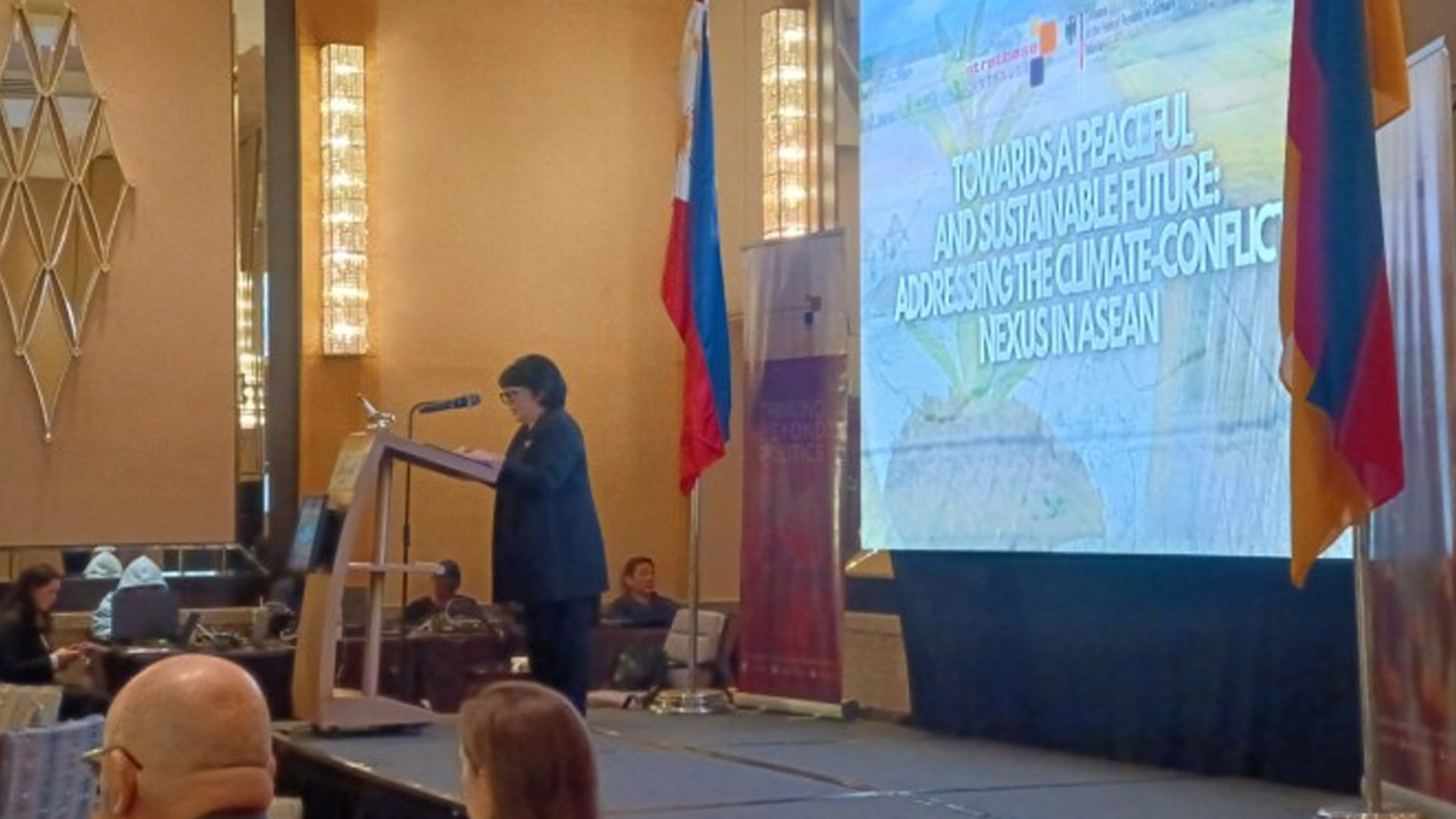
During a climate security forum organized by the Stratbase Group and the German Embassy on Monday, Environment Secretary Juan Miguel Cuna, in his video message, said that for generations, nations understood security largely in terms of borders, armed conflict, geopolitical competition, and the capacity of the state to protect its territory and its people.
He noted, however, that as the world evolves, the meaning of security also changes.
“In the Philippines, when environmental pressures affect food, water, livelihoods, public health, migration, economic opportunity, and the ability of institutions to respond, they become something more. They become challenges to human and economic security, and under certain conditions, they become threats to peace and stability,” he said, noting that climate change is now often described as a threat multiplier.
“Climate change places additional pressure on societies already contending with poverty, inequality, resource scarcity, displacement of weak institutions. In that sense, climate change rarely creates vulnerability from nothing. It finds the fault lines that already exist and widens them. That is the climate security challenge before us,” he added.
Cuna emphasized that climate action should go beyond disaster response and involve planning for long-term risks.
He said the country’s response should not be confined to disaster relief after a calamity strikes, adding that climate action needs a whole-of-society approach, as it is not the responsibility of environmental agencies alone.
Cuna said environmental resilience is tied directly to national security, noting that communities need reliable water and food, sustainable livelihoods, functioning ecosystems and resilient infrastructure to withstand shocks.
As this year’s ASEAN chair, Cuna said the Philippines has the opportunity to lead efforts to mobilize climate finance, technology, and partnerships while pushing for the region’s climate security agenda.
“Climate resilience must increasingly become part of our ASEAN’s regional security architecture. It means recognizing that regional peace and prosperity depend increasingly on our collective ability to anticipate and manage climate risks,” he said.
“We should strengthen the links among ASEAN’s political security, economic, and sociocultural communities so that climate resilience is not addressed in isolation. The region should speak with greater coherence in mobilizing the finance, technology, and partnerships needed for a just transition,” he added.
Meanwhile, Cuna also called for greater use of nature-based approaches and responsible development of the country’s mineral resources as demand for materials needed for the clean-energy transition increases.
He said responsible mineral development requires strong environmental safeguards, transparency, accountability, responsible rehabilitation, and meaningful engagement with host communities.
The Philippines, he said, needs partnerships built around long-term strengthening of institutions and communities.
“No ASEAN member state can address these challenges entirely on its own,” Cuna said.
He also urged ASEAN members to coordinate more closely and mobilize the resources needed for climate resilience.
‘Convergent risk’
Meanwhile, Special Envoy for Disaster Risk Reduction and Management Maria Antonia Yulo-Loyzaga said that climate change should be treated as a “convergent risk” because it cuts across environmental, economic, and geopolitical concerns.
In her speech, Loyzaga noted three key messages: convergent risks, interconnectedness, and local roots of regional solutions.
“First, climate change presents as a convergent risk arising from the intersection of environmental hazards and socio-cultural, economic, and geopolitical change. Second, while our interconnectedness as a region creates synergies, it also gives rise to new areas of exposure and vulnerability in natural and man-made systems. And, third, regional solutions must have local roots,” the former DENR chief said.
Loyzaga said ASEAN already has mechanisms covering disaster response, climate change, food security, biodiversity and maritime cooperation, but noted that these efforts remain fragmented.
Early warning systems
German Ambassador to the Philippines Andreas Pfaffernoschke also stressed the importance of stronger regional cooperation, urging ASEAN member-nations to strengthen regional early warning systems that combine climate science with conflict-sensitive analysis.
He also called for climate adaptation projects designed with conflict prevention in mind and for vulnerable communities and noted the importance of stronger cooperation on shared resources among ASEAN member states.
Urging the private sector, civil society, academe, and local and Indigenous communities to take part in climate action, Cuna emphasized that shared knowledge and participation are important to building resilience.
He also emphasized that climate security requires international partnerships and stressed the need to act before climate vulnerability turns into a crisis.
“Because in the end, environmental resilience and lasting peace share the same principle. We must act before vulnerability becomes crisis. Then we will have strengthened the conditions for peace itself,” Cuna said.
ASEAN members include Brunei, Cambodia, Indonesia, Laos, Malaysia, Myanmar, Philippines, Singapore, Thailand, Timor-Leste, and Vietnam. (PNA)