








Around 1,300 years ago, the first batch of Chinese merchants – faced with an upsurge of private business and instability of society – left their homeland through the shores of Jinjiang County in the southeastern Chinese coastal province of Fujian in search of new means of livelihood in foreign lands and eventually settled across more than 50 countries worldwide.
Since then, estimates place the total number of these then new breed of “migrants,” so-called overseas Chinese workers or OCW, from this county at around 5 million – some 1 million of them ended up in the Philippines.
One such migrant went by the name Ke Nan, born in Fujian’s Shangguo Village in Jinjiang in this city in 1662, who later migrated to the Philippines as Domingo Lamco and gave rise to probably one of the most important bloodlines in Philippine history. His great-great-grandson? Dr. Jose Rizal.
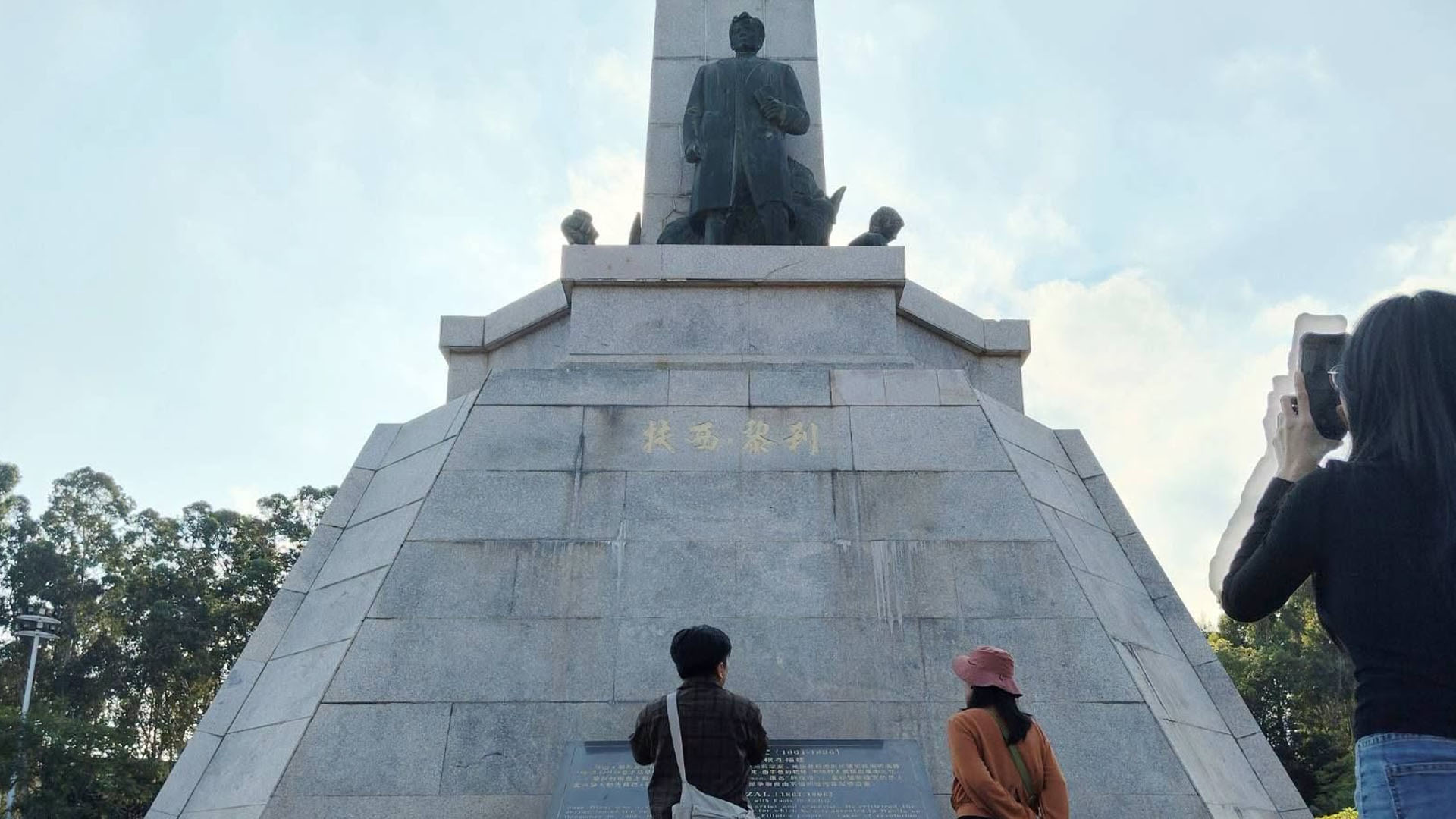
Rizal’s storied and heroic revolutionary journey – already well-known the world over – made so much impact in Fujian that an almost identical replica of the Luneta Park was built across a 5.7-hectare patch of land in Shangguo in 2006 to honor his Chinese ancestry.
Standing on an 18.61-meter monument (in honor of his birth year), the 3.3-meter bronze statue of Rizal looks over the sprawling park, the largest of its kind outside Manila and serving as a reminder of “the friendship between China and the Philippines and promotes communication between the two countries,” Shangguo Village Vice Captain Ke Jingang told a group of visiting journalists from the Philippines’ Integrated State Media last week.
Jingang said locals are very well-aware of Rizal and his contribution to Philippine independence. “The story of Jose Rizal is really famous in the village [that is why] they offered this place, which belonged to the village, [as a site] to build this park.”
Since then, important Filipino officials, like former President Joseph Estrada who attended its opening ceremony, as well as Filipino organizations and student groups have paid the park a visit.
Just a short distance from the square sits the Jinjiang Museum, where a special section is fully devoted to the Philippine martyr, featuring statues, images, and paintings – all crafted by Filipino artists and donated by the museum’s Filipino friends, including the Philippine consul general in neighboring Xiamen.
The museum, one of the largest county-level museums in China, has devised a clever way to make Rizal even more relatable and bring his story closer to visitors, especially the youth, both local and foreign ones.
“We use famous Chinese people who have a similar experience as reference to introduce Jose Rizal’s stories to teenagers because they are important persons in Chinese history just like Jose Rizal,” said Jinjiang Museum curator Lin Qianhai, citing as an example Sun Yat Sen, the revered Chinese revolutionary who overthrew the Qing Dynasty and founded the Republic of China.
“We would introduce them to Jose Rizal’s story and tell them he is regarded as a national hero of the Philippines,” he added.
While the museum has a vast collection tracing the steps of the overseas Chinese across Southeast Asia, around half of it is exclusively about the Philippines. Apart from Rizal, also featured at the museum are images of former Philippine presidents like Estrada and Gloria Macapagal-Arroyo, as well as prominent Filipino tycoons with Chinese roots including Henry Sy and Lucio Tan, both born in Fujian.
“We put this content at this museum to show what the Jinjiang people did in Southeast Asia… so this is also about our Chinese ancestors’ contribution, to some degree,” he said.
Another of these eventual overseas Chinese tycoons also left his mark on Fujian soil and built the famous Yang Family Mansion at the Houganbing Village in Yonging Town, Sishi City, also in Quanzhou.
Yang Bangsuo, a Chinese trader who settled and made a living in the Philippines with his brothers at the height of the Jinjiang migration, returned to China in the 1920s to build the rear section of the mansion, completed in 1933 and blends Chinese and western architectural styles.
Regarded as one of the largest residences built by an overseas Chinese in Quanzhou, the mansion, also called the “Ninety-Nine Room Historic Residence,” houses more than 100 rooms, accommodating 300 families at its peak.
Apart from Quanzhou, the city of Zhangzhou, still in Fujian, also traces its role and links to other countries, including the Philippines, via the Maritime Silk Road, a vast ancient network of sea trade routes connecting Southeast Asia, East Asia, the Indian subcontinent, the Arabian Peninsula, eastern Africa, and Europe.
Home to more than 11,000 cultural relics from the ancient maritime trade route, the Zhangzhou Museum features Pan Zhencheng, a Chinese merchant whose family hails from Zhangzhou, was able to travel to Luzon three times selling silk and tea.
Visitors of this museum are greeted at the entrance with a passage that says the cultural exchange that came with the maritime trade “unveiled a magnificent landscape of early modern globalization with a far-reaching impact on human culture. We are supposed to follow the example of our forefathers by benefitting from cooperation and joint contribution to an ideal world.”
Be it Rizal’s ancestor, merchant Bangsuo, or these ancient maritime trade routes taken by many overseas Chinese, who came before and after them, all of them – in one way or another – played a central role in this cooperation and joint contribution to a shared history and a two-way cultural exchange between the Philippines and China, something kept alive to this day. (PNA)