



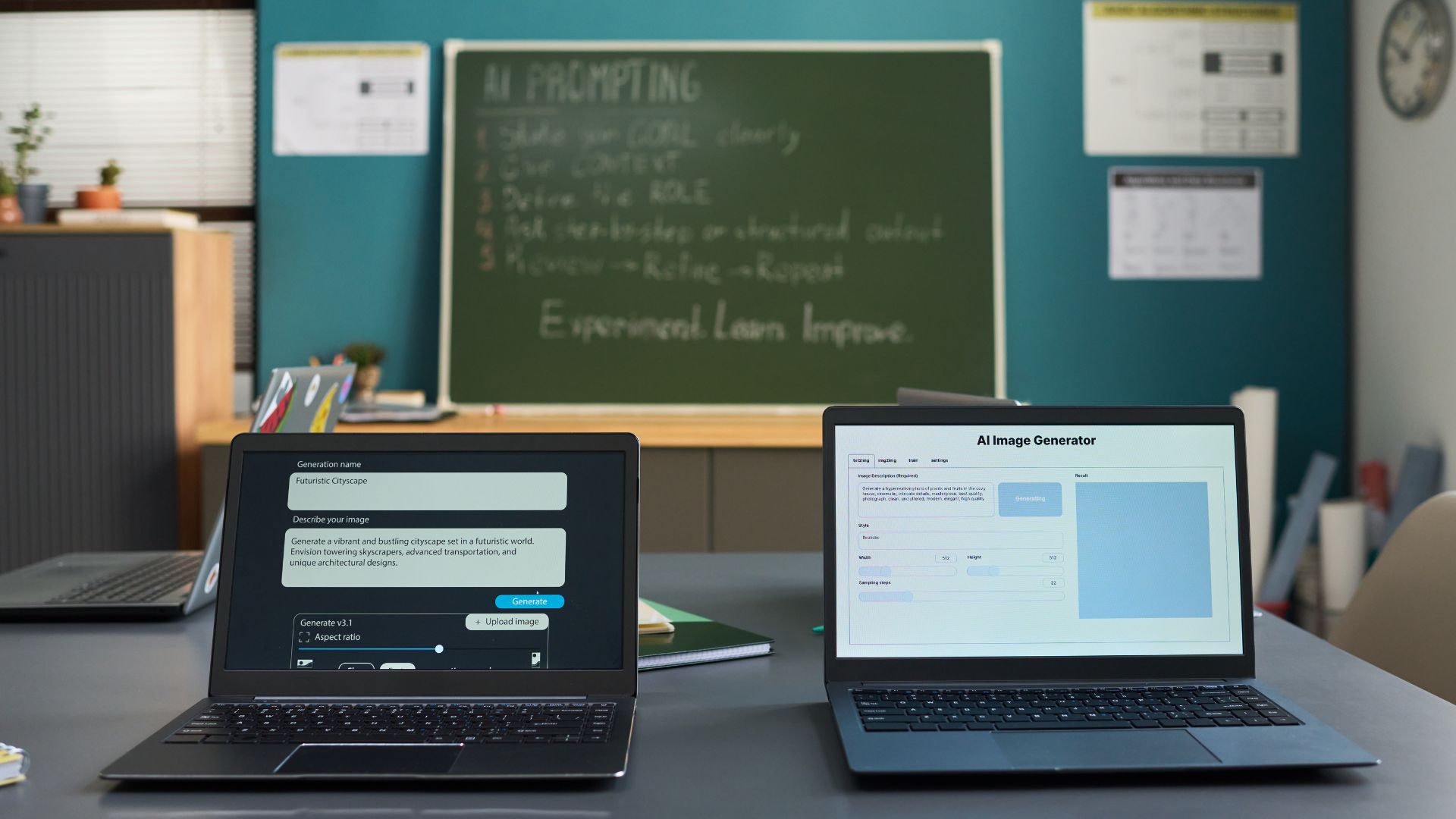







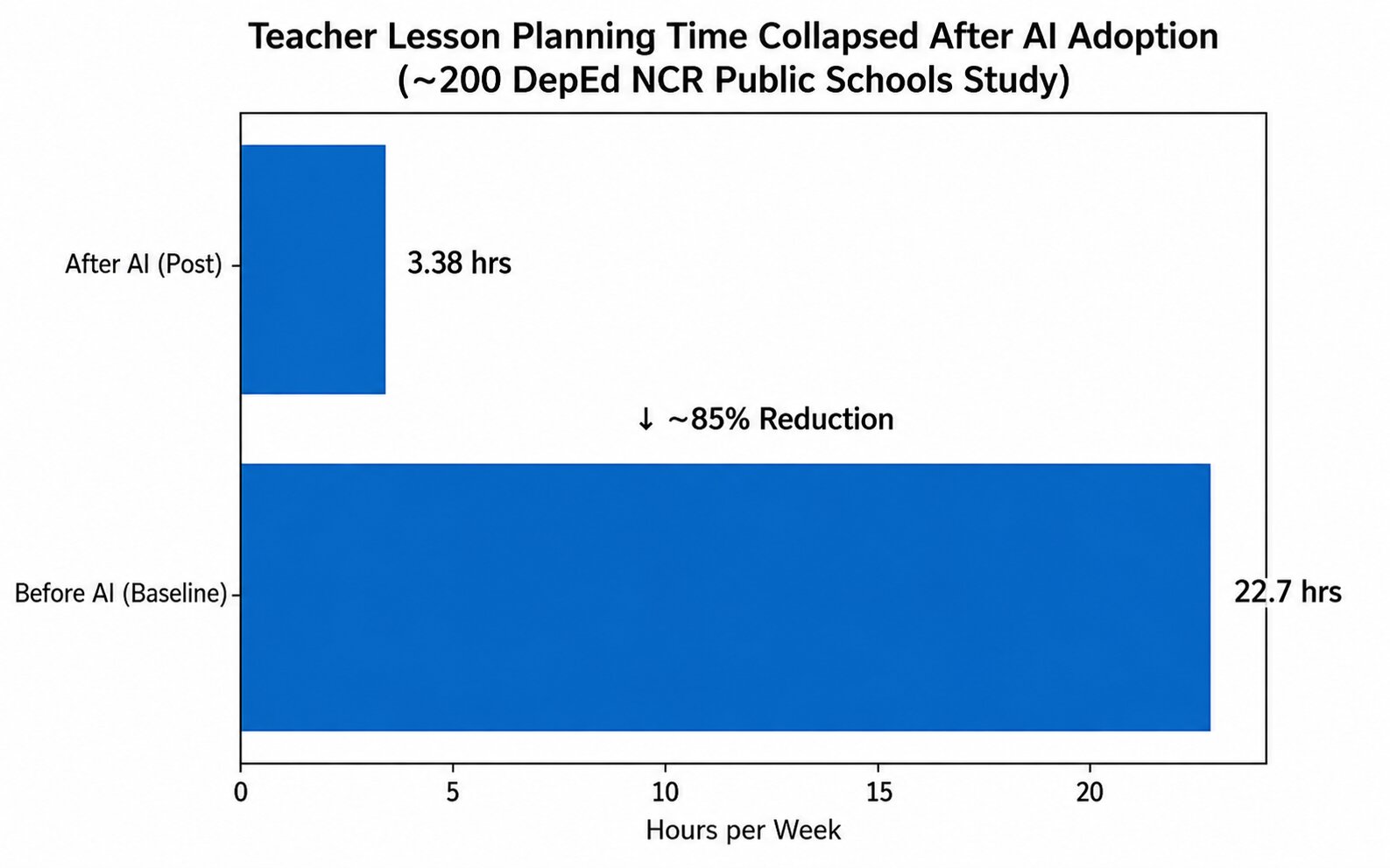
Teachers in the Philippines are already using artificial intelligence to dramatically reduce their workload, cutting time spent on tasks such as lesson planning by as much as 85 percent. Yet despite these gains, schools and institutions are struggling to sustain the benefits, according to a new national study.
The study, presented on April 19 at the International Academic Forum in Washington, D.C., reveals a growing disconnect between classroom practice and institutional readiness. While teachers are rapidly adopting AI tools, systems meant to support them have yet to catch up.
“The challenge is no longer the technology. It is whether institutions are willing and able to respond to it,” said Christian S. Manansala, executive director of Tagpros and lead presenter of the study. “We did not fail to adopt AI. We failed to build systems that allow it to last.”

The research covered approximately 200 public schools during the most recent academic year and was conducted in collaboration with Department of Education – National Capital Region and Philippine Normal University, with support from Globe Telecom, Wipro, and PAGEONE Group.
Findings show that teachers typically spend between 35 to 40 hours a week on non-instructional tasks. With AI tools, lesson planning time alone dropped from an average of 22.7 hours to as low as 3.38 hours weekly. In many cases, tasks that once required a full day could be completed within hours.
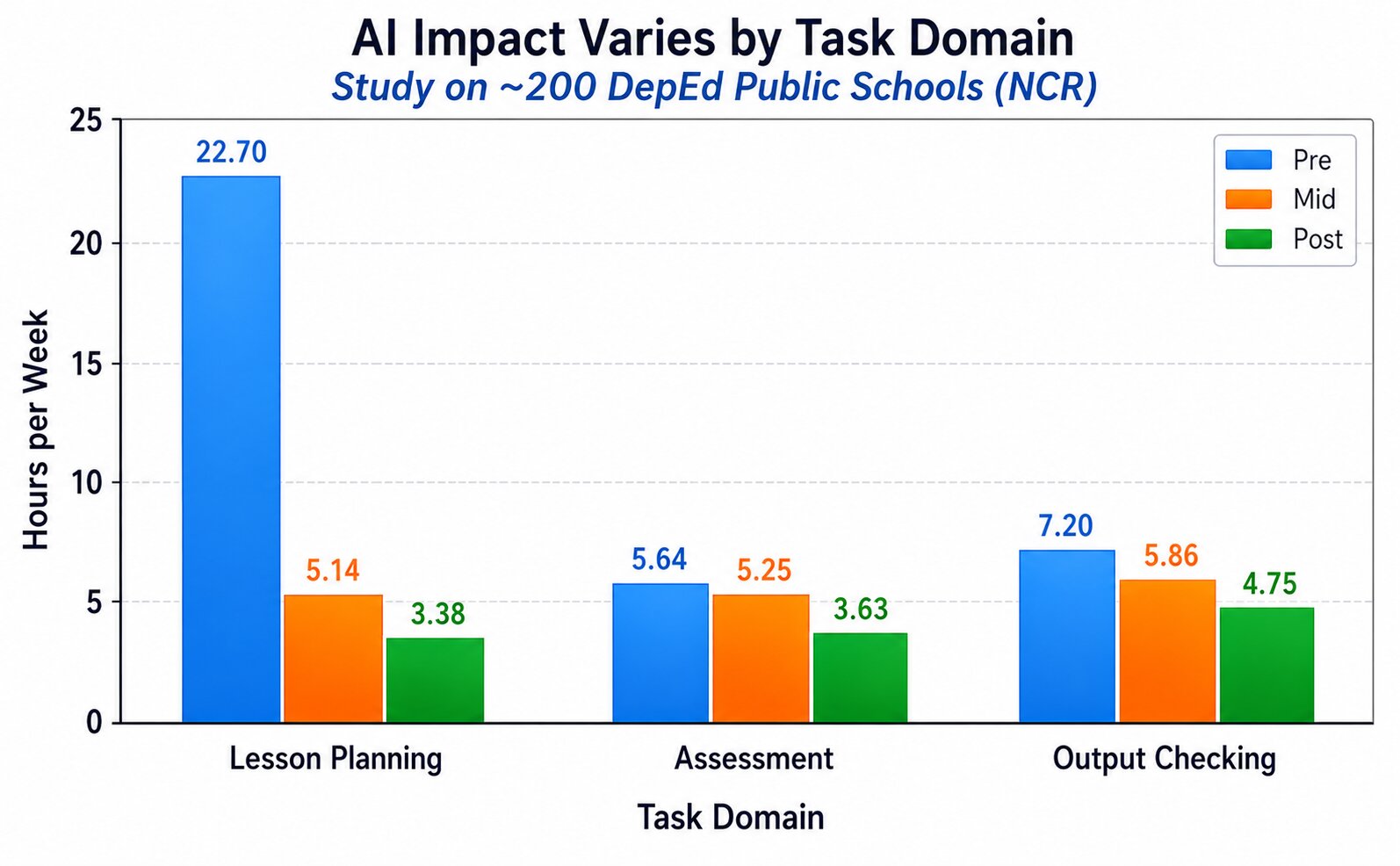
Despite these improvements, the study found that gains are often short lived. Without structured guidance, consistent training, and institutional alignment, early efficiencies tend to fade over time.
This places teachers and systems on different timelines. Classrooms are already integrating AI into daily practice, while institutions remain in the early stages of policy development and implementation.
The research utilized GabAI, a platform developed by Tagpros and incubated under UPSCALE, a joint initiative of the Department of Science and Technology and the University of the Philippines Diliman. The platform enabled both teacher support and real time insights into how AI is being used across classrooms.
The implications extend beyond efficiency. At a time when the Philippines continues to face challenges in mathematics and reading performance based on recent Programme for International Student Assessment results, the findings raise a critical question. If effective tools already exist in classrooms, why are they not translating into system wide improvements?
“As an educator for over two decades, I have seen how much time teachers spend outside the classroom just trying to keep up,” Manansala said. “What is striking is that we now have tools that can significantly reduce that burden. But without system support, those gains remain isolated.”
The study also highlights emerging risks. Limited institutional visibility into AI use makes it harder to detect misuse, including concerns related to misinformation and deepfakes.
Earlier this year, the findings were shared with officials from the Embassy of the Philippines in Washington, D.C., including Deputy Chief of Mission Felipe F. Cariño III and Minister and Consul Hans Mohaimin L. Siriban. Discussions emphasized that AI adoption in education is moving faster than governance frameworks designed to guide it.
Similar concerns are emerging globally. Conversations with groups such as the Virginia Department of Education, the Virginia School Boards Association, and the Metropolitan Washington Council of Governments indicate a shift in focus from access to AI toward issues of visibility, governance, and institutional readiness.
For corporate and development partners, the study points to a gap in current investments. Much of today’s funding prioritizes access to AI tools, but not the systems required to sustain their impact.
“We are investing in AI access but not in the systems that make its impact last,” Manansala said.
As the next school year approaches, educators are expected to face the same pressures of heavy workloads and limited preparation time, despite clear evidence that these can be reduced.
The study concludes that the core challenge has shifted. The issue is no longer whether AI works in education. It is whether institutions can keep pace with its adoption.
Manansala said the findings will be shared with the Philippine Legislature and the Office of the President to inform national AI policy, noting that the country has an opportunity to position itself as a leader in AI driven education if supported at scale.
“The debate is no longer whether AI should be used,” he said. “It is who is responsible for making its benefits last.”