


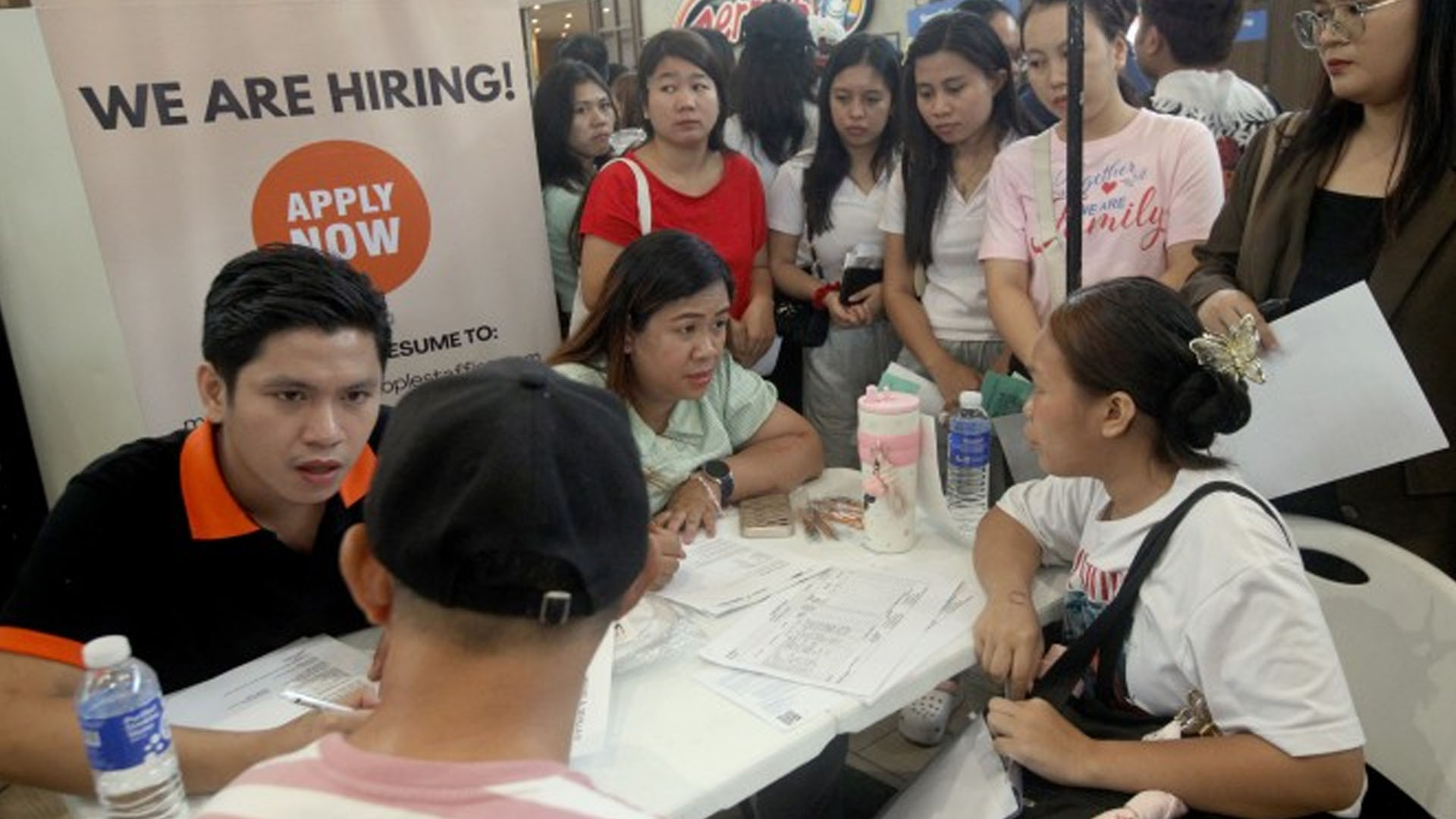






Despite continued growth in the Filipino educated workforce, millions remain unemployed or underemployed, the Commission on Population and Development (CPD) said on Friday.
CPD Executive Director and Undersecretary Lisa Grace Bersales warned that the country may fail to maximize its demographic advantage if job creation efforts are not strengthened.
“Population growth must be matched with the creation of quality, decent, and sustainable jobs,” she said in a news release.
Bersales noted that while population is a resource, human capital becomes an economic asset only when people are healthy, educated and employed, adding that a growing workforce alone does not automatically translate into economic gains.
“A large working-age population without opportunities for decent work is not a demographic dividend – it can become a demographic burden,” she stressed.
The CPD noted that the country’s working-age population, those aged 15 to 64, now accounts for 63.9 percent of the total population.
If matched with adequate employment opportunities and investments in human capital, the agency said that this could fuel economic growth.
However, the CPD said labor data showed a 5 percent increase in the unemployment rate in March 2026, from 3.9 percent in the same period last year, which is equivalent to around 2.58 million unemployed Filipinos.
Meanwhile, the labor force participation rate also reached 63.3 percent in March 2026, representing 51.65 million economically active Filipinos, of whom about 49.07 million were employed, but 6.03 million were still underemployed.
The CPD also pointed to the disconnect between women’s educational performance and their participation in the workforce.
Based on the 2024 Functional Literacy, Education, and Mass Media Survey, women posted higher literacy rates than men, recording a 90.9 percent basic literacy rate compared to 89 percent among males.
Women also registered a 74.1 percent functional literacy rate.
Despite this, female labor force participation remained significantly lower at 52.8 percent in 2026 and 52.5 percent in 2025, compared to 73.7 percent and 73.1 percent among men, respectively.
The CPD underscored the need for policies that would help women translate educational gains into economic participation.
Meanwhile, the CPD added that youth employment also remains a challenge, despite a 30.6 percent increase in labor force participation among Filipinos aged 15 to 24 in March 2026, up from 29.4 percent in March 2025.
It said that while around 5.76 million young Filipinos were employed, about 828,000 remained unemployed, and 753,000 were underemployed.
“When young people are productively employed, the country benefits from higher productivity, stronger consumer spending, and sustained economic growth,” Bersales said.
“Young people are drivers of economic growth and national well-being. A whole-of-nation approach is needed to ensure that they have access to continuing education, skills development, and quality employment opportunities,” she added.
The CPD said realizing the country’s demographic dividend would depend on sustained investments in education, healthcare, social services, and skills development to prepare Filipinos for the demands of the labor market.
Bersales highlighted the agency’s call for continuing investments in the nation’s human capital to ensure that Filipinos are healthy, educated, and equipped with skills that match the demands of the labor market. (PNA)